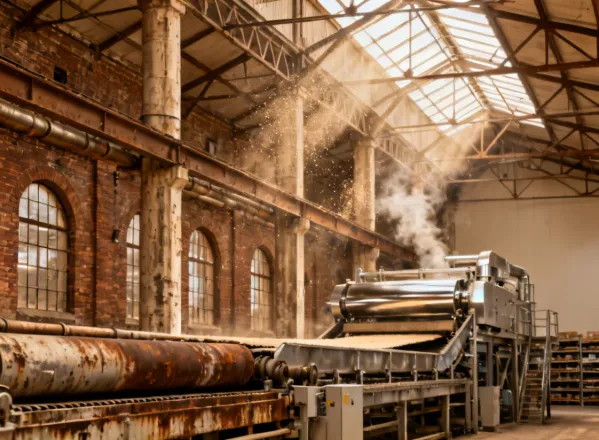
Since 1937, ROCKWOOL has transformed volcanic basalt rock into insulation products that protect buildings, the people inside them, and the environment around them.
ROCKWOOL's origin traces to the observation that volcanic lava, when disrupted by high winds, forms natural glass wool fibers — a phenomenon observed in Hawaiian volcanic activity. In 1937, Danish engineers replicated this process industrially, melting basalt rock at 1,600°C and spinning it into durable mineral fiber with natural fire resistance, thermal stability, and acoustic mass.
Over 85 years, that foundational process has been refined across 38 manufacturing facilities in 40+ countries, but the core principle has not changed: stone, unlike synthetic polymers, does not burn, does not compress permanently, and does not degrade over a building's lifetime under normal conditions.
Every ROCKWOOL product carries Euroclass A1 non-combustibility classification — the highest achievable under EN 13501-1. We believe insulation should never be a fuel source in a building fire. This is not a marketing claim; it is a material property of basalt rock that we maintain rigorously across all products through the EUCEB certification program.
We maintain a publicly accessible technical documentation library covering test reports, Environmental Product Declarations (EPDs), and product data sheets for every major product line. Performance claims on this website correspond to published test data from accredited laboratories including SGS, Intertek, and UL. We provide certificate copies on request with no obligation.
Stone wool insulation has a documented 6-month energy payback period based on third-party life cycle analysis — meaning the embodied carbon of manufacturing is offset in 6 months of building thermal performance. Our net-zero manufacturing target is 2030, with Scope 1 & 2 reductions tracked annually. We publish our progress in public sustainability reports.
Chief Technology Officer
26 years in mineral fiber engineering and product development
Director of Sustainability
Environmental EPD author, ISO 14001 lead auditor
Head of Fire Engineering
Passive fire protection specialist, ASTM E119 test committee member
Head of Acoustic Research
PhD Architectural Acoustics, 18 years in building acoustics testingContact our technical team for product documentation, project consultations, or to connect with a regional distributor.